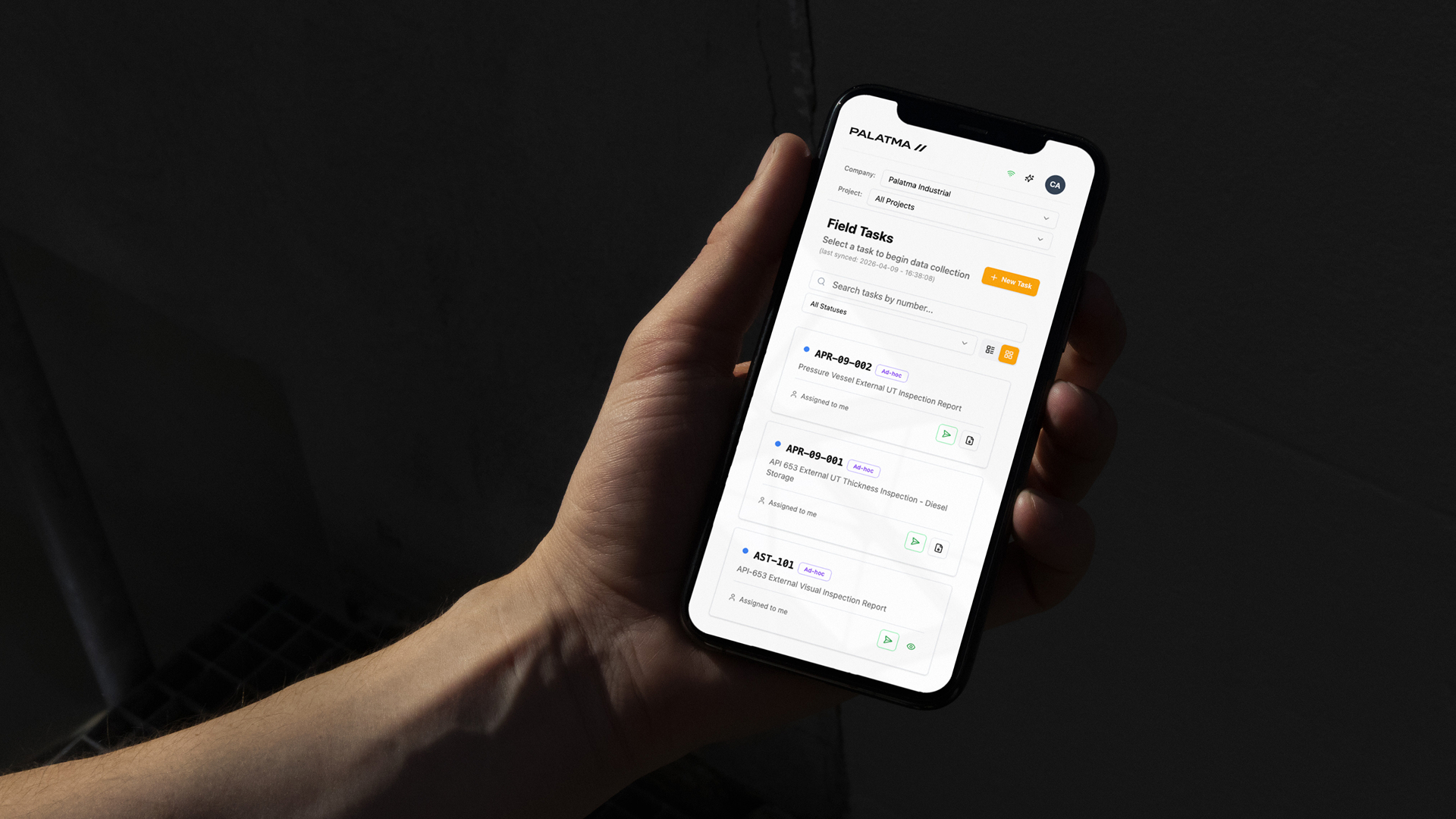

From Field Inspection to Final Report: How Ormin Connects the Entire Workflow
How Ormin connects field capture, approvals, reporting, and operational visibility in one controlled inspection workflow.
Industrial inspection has always had a documentation problem. The work happens in the field, but the evidence ends up scattered across phones, tablets, cameras, notebooks, spreadsheets, PDFs, emails, and whatever file naming system the last project manager happened to prefer. The final record is a different story. It has to be clean, complete, traceable, reviewable, and ready to stand up long after the job is closed. The gap between how data is captured and how it ultimately has to be presented is where most inspection teams lose time.
The pattern is familiar. An inspector completes the walkthrough, but someone else has to track down the photos. A third person builds the report. A supervisor reviews the findings, then a mechanical integrity engineer asks for missing context. The task gets kicked back, and the closeout clock keeps running. Each handoff creates a silo, and each silo adds delay. We built Ormin to close that gap. Inspection and reporting should be connected from the start, not treated as two separate jobs handed off between two separate teams.
Ormin gives operators, inspectors, supervisors, and field crews a single controlled workflow for collecting, verifying, routing, approving, and reporting critical inspection data. The work that happens in the field and the record that lives afterward are part of the same flow, not two disconnected efforts.
A Field App Built for Industrial Workflows
Most field teams do not need another generic form app. They need a workflow that reflects how industrial inspection work actually happens. That means tasks assigned to the right people, forms that match the inspection type, structured data instead of free-form notes, photos that stay attached to the record, and location history captured at the moment of work. Approvals have to move through the right reviewers, and reports need to come together without rebuilding the job from scratch.
Ormin is designed around that complete inspection lifecycle, and it draws a clean line between two kinds of users. Administrative teams manage templates, forms, users, dashboards, approvals, client accounts, field definitions, and task triggers from the desktop. Field users execute the work in the app by completing tasks, submitting for signoff, attaching photos, capturing voice notes, and generating reports, online or offline.
The operating idea is simple: manage from your desk, execute on the app. That separation matters. Office teams need control. Field teams need speed. Ormin gives both sides a shared system without forcing every user into the same interface.
From To-Do to To-Done
Inspection work does not end when a form is filled out. It ends when the work is documented, reviewed, approved, and ready to be used. Ormin gives teams a straight path from assignment to closeout. A task is created, assigned, completed in the field, submitted for review, routed through an approval workflow, and exported into a client-ready report, with every step tied back to the original work record. For field teams, that means less backtracking. For supervisors, it means clearer accountability. For clients and asset owners, it means better documentation, every time.
The platform supports the inspection and NDT workflows teams already run, including API 653 external visual inspection reports, API 570 visual inspections, pressure vessel external UT inspection reports, ET shooter sheets, CML data collection, and non-conformance escalation workflows. That makes Ormin useful for both routine inspection programs and more specialized field work where findings need to move quickly into review, engineering, maintenance planning, or corrective action.
Forms Built Around the Way Teams Actually Work
One of the biggest problems with field software is rigidity. The form does not match the job, so teams work around it. They add notes, upload separate PDFs, and track exceptions somewhere else. Over time, the "system of record" becomes more of a suggestion than a reality.
Ormin approaches forms differently. Teams can build custom forms around their actual workflows, use pre-built templates, create reusable form blocks, define field logic, and configure required inputs. Forms can be adapted for different inspection types, job scopes, clients, assets, or approval paths.
The platform also supports custom field logic for dynamic behavior. That includes calculations, visibility rules, required fields, and operator-based formulas that respond to the data being entered. For inspection teams working with readings, minimum thickness values, percent-from-threshold calculations, or pass/fail criteria, this turns the form into more than a digital checklist. It becomes part of the workflow control layer.
To make the transition off paper or legacy systems easier, teams can scan and import PDFs of existing inspection forms or generate new ones with OrminAI. There are multiple ways into the platform, so existing processes don't have to be rebuilt from zero.
Built-In Signoff and Approval Workflows
Inspection records are only useful if they can be trusted, and that trust comes from process. Who performed the work? Who reviewed it? Was it accepted, rejected, or escalated? Was engineering involved? Did maintenance planning receive the report? Was the performer notified after submission?
Ormin keeps review and approval tied directly to the work. Teams can define approval workflows based on inspection type, role, location, asset type, or workflow stage. A non-conformance escalation, for example, might route from a field inspection supervisor to a QA/QC manager, then to a mechanical integrity engineer, then to a maintenance planner. Triggered actions can notify reviewers, send reports, update assignments, or move the task into the next stage automatically.
This matters because approvals are usually where field work slows down. The inspection itself may be complete, but the record sits in limbo because the next person does not know they need to act, does not have the report, or does not have the supporting evidence. Ormin removes that ambiguity by making the next step visible to the person who owns it.
Photos, Voice Notes, and Location History in the Same Record
Field documentation is more than text. A useful inspection record typically includes photos, readings, observations, voice notes, attachments, signatures, and location context. When those pieces are captured separately, the final report becomes harder to assemble and harder to defend.
Ormin keeps everything attached to the same record. Users can attach photos directly to inspection tasks and include media in exported reports. The app supports voice capture, so inspectors can narrate observations, readings, and follow-up notes while moving through the field. That helps teams working around equipment, inside facilities, or across large sites where stopping to type every detail isn't realistic.
Location history adds another layer of context. Ormin automatically records the user's location when form data is saved, tying individual entries to where the work was actually done. The result is a clearer timeline and less ambiguity after the fact, which becomes especially valuable when crews are moving across multiple assets, areas, tanks, units, or facilities in a single day.
Reports Without the Paperwork Drag
A field app is only as useful as the output it produces. If the team still has to rebuild the final report manually, the workflow is not finished. It is just digitized halfway.
Ormin generates client-ready reports from the same data collected in the field. Reports can include inspection details, photos, notes, supporting documentation, and branded cover sheets. Users can download reports directly from the app, submit them for review, or include them as part of a larger approval process. For inspection service providers, that means faster delivery to clients. For owner-operators, it means cleaner records for internal review, compliance, asset history, and future planning. The report stops being a separate administrative burden and becomes the natural output of the completed workflow.
Online and Offline Support for Real Field Conditions
Industrial sites are not built around perfect connectivity. Teams work in tanks, yards, pipe racks, remote locations, processing areas, mechanical rooms, terminals, and facilities where signal is unreliable at best. A field app that fails when the connection drops is not really a field app. It is an office app with a smaller screen.
Ormin supports both online and offline work. Data captured offline is stored locally and syncs once a connection is restored, so teams keep moving when connectivity is poor and don't have to re-enter data after the fact. For inspectors, that means less friction. For managers, it means less risk of missing or duplicated information.
Dashboards and KPIs for Better Visibility
Inspection data should not disappear into a folder after it is submitted. Ormin includes dashboards and KPI tools that help teams track performance across tasks, forms, assets, teams, and workflows. Supervisors can see what is in progress, what needs approval, what is complete, and where bottlenecks are forming.
For larger organizations, this is where field execution turns into operational intelligence. The same data collected during an inspection helps managers understand workload, completion rates, approval queues, recurring issues, and team performance. The goal isn't just to collect more data. It's to make inspection work easier to manage while it's happening.
OrminAI: Faster Task Creation and Workflow Support
Ormin also includes an AI assistant built directly into the platform. OrminAI supports task creation, assignment workflows, approval queries, and task data questions. It answers prompts like creating tasks for a project, showing unassigned tasks, checking what needs approval, or surfacing the status of in-progress work.
For field and operations teams, this adds a more modern interface layer on top of the system. Instead of relying only on filters, tables, and menus, users can ask for the information or action they need inside the workflow itself. Used well, it cuts administrative drag and helps teams move faster through the routine task management steps that pile up over a day.
Why Ormin Matters Now
Industrial teams are under pressure to do more with less. Inspection programs are growing more complex, documentation requirements aren't getting any lighter, asset owners want better visibility, and service providers need faster closeout. Supervisors need cleaner accountability, and field teams need tools that don't slow them down.
Ormin is built for that environment. It gives teams a structured way to move field work through capture, verification, approval, and reporting without scattering the record across multiple systems. It also gives organizations a foundation for more consistent data, cleaner handoffs, faster reporting, and better visibility into work status.
The larger point is simple. Field data should not become useful only after someone cleans it up. It should be useful the moment it is captured.
Ormin is available now for teams looking to modernize field inspection, task execution, approvals, and report generation. For operators, inspectors, supervisors, and service providers, it offers a faster path from assigned work to signed-off documentation, with forms, approvals, accountability, evidence, and outputs all living inside a single controlled workflow.
Move inspection work from assigned to approved without rebuilding the record.
Ormin connects field data capture, signoff, approvals, evidence, and reporting in one controlled workflow built for industrial teams.
Explore Ormin